
Registration essential.
Scan the code, or visit the SLAFAR website for the full agenda and concept note: slafar.lk/ocean-accounting
CONTACT
SLAFAR – Dr S.T. Gonapinuwala, suchimatg@wyb.ac.lk
GOAP Secretariat, UNSW Sydney- Dr Jordan Gacutan, j.gacutan@unsw.edu.au

Concept Note
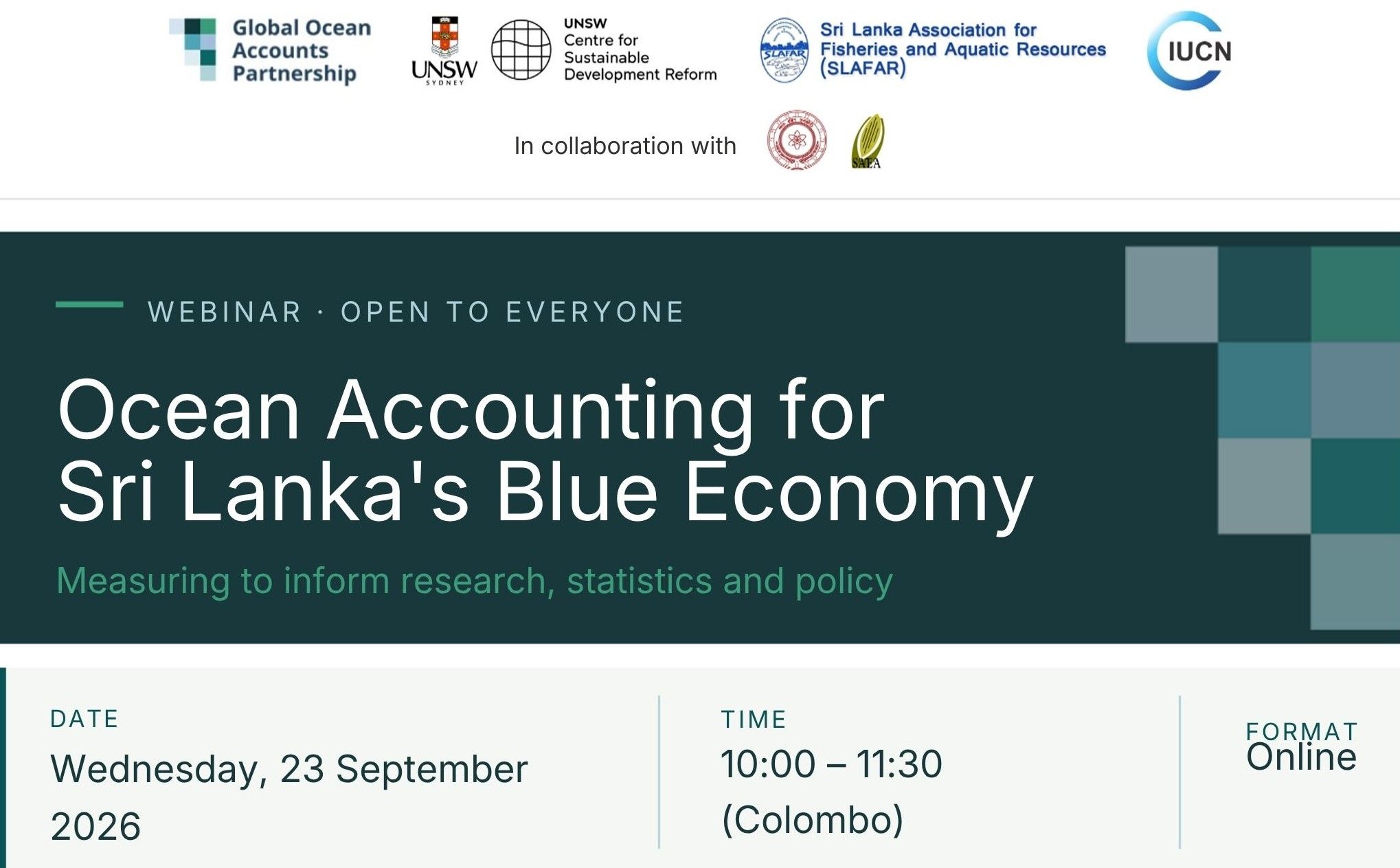
The Sri Lanka Association for Fisheries and Aquatic Resources (SLAFAR), in collaboration with the Global Ocean Accounts Partnership (GOAP) Secretariat at the UNSW Centre for Sustainable Development Reform (CSDR), and with support from the International Union for Conservation of Nature (IUCN) Sri Lanka, will host this online event on Wednesday 23 September 2026.
Sri Lanka’s oceans support the economic growth, livelihood and wellbeing of coastal communities. Sectors such as fisheries, aquaculture, and tourism, draw on services provided by key ocean ecosystems, including coral reefs, seagrass meadows and mangroves. Governments approach the subject with three questions:
- how much of the national economy depends on ocean resources,
- who receives the benefit, and
- whether that benefit can be sustained.
Ocean Accounting was designed to extend UN standards, to bring the evidence together to answer these questions. The momentum for ocean accounts is driven by the momentum for “blue economy” commitments, which are made at regional and multilateral fora. Blue economy strategies and ocean accounting pilots are advancing in parallel globally, and comparability between them depends on shared definitions. The accounts organize environmental, economic and social data on a common framework, so that ocean figures can be set beside GDP and official statistics, and it records both the stocks (fish stocks, reef extent and condition, vessels and port infrastructure) and the flows between them (fisheries and tourism production, subsistence use, and ecosystem services).
The obstacle is not an absence of data but its fragmentation. Information on catch, coastal land use, ecosystem condition, tourism receipts and public expenditure sits with separate institutions and is compiled to different classifications and periods, so ocean activity is rarely assembled as an economy. The Ocean Accounts Technical Guidance[1] defines the blue economy as the sustainable, equitable and socially inclusive use of ocean resources to benefit economies, livelihoods and ecosystem health.
Sri Lanka’s policy commitments already call for that evidence.
- The National Climate Finance Strategy 2025–2030 includes accounting among its instruments and identifies fisheries among the priorities for investment alongside renewable energy, agriculture and resilient infrastructure.
- The Central Bank of Sri Lanka Sustainable Finance Roadmap 2.0, launched on 05 May 2025 for the period 2025–2029, aims to mobilise USD 10.85 billion by 2030 in support of the country’s Nationally Determined Contribution, and
- the Green Finance Taxonomy issued by the Central Bank in May 2022 classifies marine and coastal ecosystem activities among those eligible.
Each rests on a measured baseline and there is a need to organize the information in order to operationalize these policies towards a sustainable blue economy.
The Global Ocean Accounts Partnership is a multi-institutional partnership, composed of 23 national governments, and has supported over 20 countries in delivering training and technical assistance since 2019. It is currently co-chaired by the Ministry of Marine Affairs and Fisheries, Republic of Indonesia and Charles Darwin Foundation, Ecuador. The Secretariat is based at the University of New South Wales – Centre for Sustainable Development Reform.
The proposal is a single 90-minute online webinar on 23 September 2026, convened jointly by SLAFAR with the GOAP Secretariat as technical partner and addressed to membership and partner institutions.
What is asked of each party:
- Each convening association: to nominate a speaker or panellist, and to circulate the invitation to its membership;
- IUCN Sri Lanka: the closing technical slot on opportunities for Sri Lanka; and
- GOAP Secretariat: the technical programme, facilitation, recording and post-event materials.
- SLAFAR provides the policy forum for scientists, academics and industry working on fisheries and aquatic resources, and disseminates research through the Sri Lanka Journal of Aquatic Sciences.
- SAEA, formed in 1992, unites agricultural economists across academic, research and development institutions.
- SLAAS, founded in 1944 and incorporated by Act of Parliament No 11 of 1966, provides science-based advice to government and private institutions.
The proposed webinar aims to build shared understanding of how Ocean Accounting measures the blue economy and where it can support national decisions, and the specific objectives are to:
- Introduce the Ocean Accounting framework and its application to measurement of the blue economy;
- Set out how ocean accounts support fisheries and aquatic resource management, resource and agricultural economics research, and science-based policy advice;
- Share ocean accounting experience from across the Indian Ocean region, including Indonesia, and identify where regional collaboration on definitions and boundaries would make national figures comparable;
- Explore priority entry points for ocean accounting in national statistics, sector planning and climate finance; and
- Introduce the Ocean Accounts Technical Guidance, invite comment on it whilst consultation is open, and identify training and capacity-building needs across the audiences the associations address.
The proposed webinar aims to build shared understanding of how Ocean Accounting measures the blue economy and where it can support national decisions, and the specific objectives are to:
- Introduce the Ocean Accounting framework and its application to measurement of the blue economy;
- Set out how ocean accounts support fisheries and aquatic resource management, resource and agricultural economics research, and science-based policy advice;
- Share ocean accounting experience from across the Indian Ocean region, including Indonesia, and identify where regional collaboration on definitions and boundaries would make national figures comparable;
- Explore priority entry points for ocean accounting in national statistics, sector planning and climate finance; and
- Introduce the Ocean Accounts Technical Guidance, invite comment on it whilst consultation is open, and identify training and capacity-building needs across the audiences the associations address.
This webinar is designed for members of the convening associations and their partner institutions who are:
- Researchers and academics working on fisheries, aquatic resources, coastal ecosystems and resource economics;
- National accountants, statisticians and officials integrating environmental and economic data;
- Policymakers and technical officials in fisheries, environment, planning, finance and foreign affairs;
- Development partners, intergovernmental bodies and donors supporting ocean and coastal investment; and
- Private sector and civil society stakeholders whose operations depend on healthy marine ecosystems.
- Working knowledge of Ocean Accounting and its use in measuring and managing the blue economy;
- Shared understanding across the three associations of Sri Lanka’s existing data holdings and the gaps that constrain ocean accounts;
- A recorded set of priority entry points for ocean accounting in national statistics, sector planning, climate finance and the positions Sri Lanka takes in regional and multilateral fora; and
- Comment from the associations’ audiences on the Ocean Accounts Technical Guidance, recorded for the consultation, and exploration of a continuing training and capacity-building relationship between the associations and the GOAP Secretariat.
AGENDA (90 MIN)
| Time | Agenda item | Speaker |
| 5 minutes | Opening remarks | |
| 3 minutes | Welcome and objectives of the webinar | Dr Suchima Gonapinuwala (SLAFAR) |
| – | Group photo | – |
| 15 minutes | Policy overview: parallel momentum on the blue economy and on ocean accounts, and the need for a common baseline | Dr Ben Milligan, Secretariat Director, GOAP |
| 15 minutes | Ocean Accounting for fisheries and aquaculture | Dr Jordan Gacutan (GOAP) |
| 5 minutes | Break | – |
| 10 minutes | Ocean Accounting experience from Indonesia: linking licensing, management and policy (GEF-8) | Mr Yoga Dewanto, GOAP Secretariat (Indonesia lead) |
| 10 minutes | Opportunities for Sri Lanka | Dr Shamen Vidanage, IUCN Sri Lanka |
| 20 minutes | Discussion and Q&A, including comment on the Ocean Accounts Technical Guidance and on training and capacity-building needs | Facilitated by GOAP |
| 5 minutes | Closing remarks |
The session will be recorded and published with the presentation slides. Consent to record is sought at registration, and any speaker may decline to have their remarks published.
CONTACTS
- Sri Lanka Association for Fisheries and Aquatic Resources (SLAFAR): Dr Suchima Gonapinuwala, suchimatg@wyb.ac.lk
- GOAP Secretariat, UNSW Sydney: Dr Jordan Gacutan (gacutan@unsw.edu.au)
- IUCN Sri Lanka: Dr Shamen Vidanage, Country Representative (Vidanage@iucn.org)
LEARN MORE
- What are Ocean Accounts (FAQs): https://www.oceanaccounts.org/tag/ocean-accounts/
- Ocean Accounts across IORA Member States: https://events.sustainabledevelopmentreform.org/lvWFcntiNlsfMs
- Ocean Accounts Technical Guidance, circulars and consultation: https://guidance.oceanaccounts.org/
- Ocean Accounts Technical Guidance, general introduction: https://guidance.oceanaccounts.org/circulars/section-0/0-1-general-introduction/
- Ocean Accounts Technical Guidance, the ocean and blue economy: https://guidance.oceanaccounts.org/circulars/section-1/1-0-ocean-blue-economy/